
Free parcel locker delivery: Baltics from 49 € • Finland from 79 € • For regular-price products only.
Good to know
Intimate accessories on a flight: check before packing
Start with the rules
Before packing an intimate accessory, check the airline, airport and destination rules. Permission to carry an item in luggage does not settle every question: batteries, liquids and import restrictions may be regulated separately.
Pay attention to batteries
EASA prefers carry-on luggage for battery-powered electronics. Do not pack damaged batteries. Spare batteries and power banks belong in carry-on luggage with protection against short circuits. Check your device specifications and airline conditions, particularly for higher capacities.
Prevent accidental activation
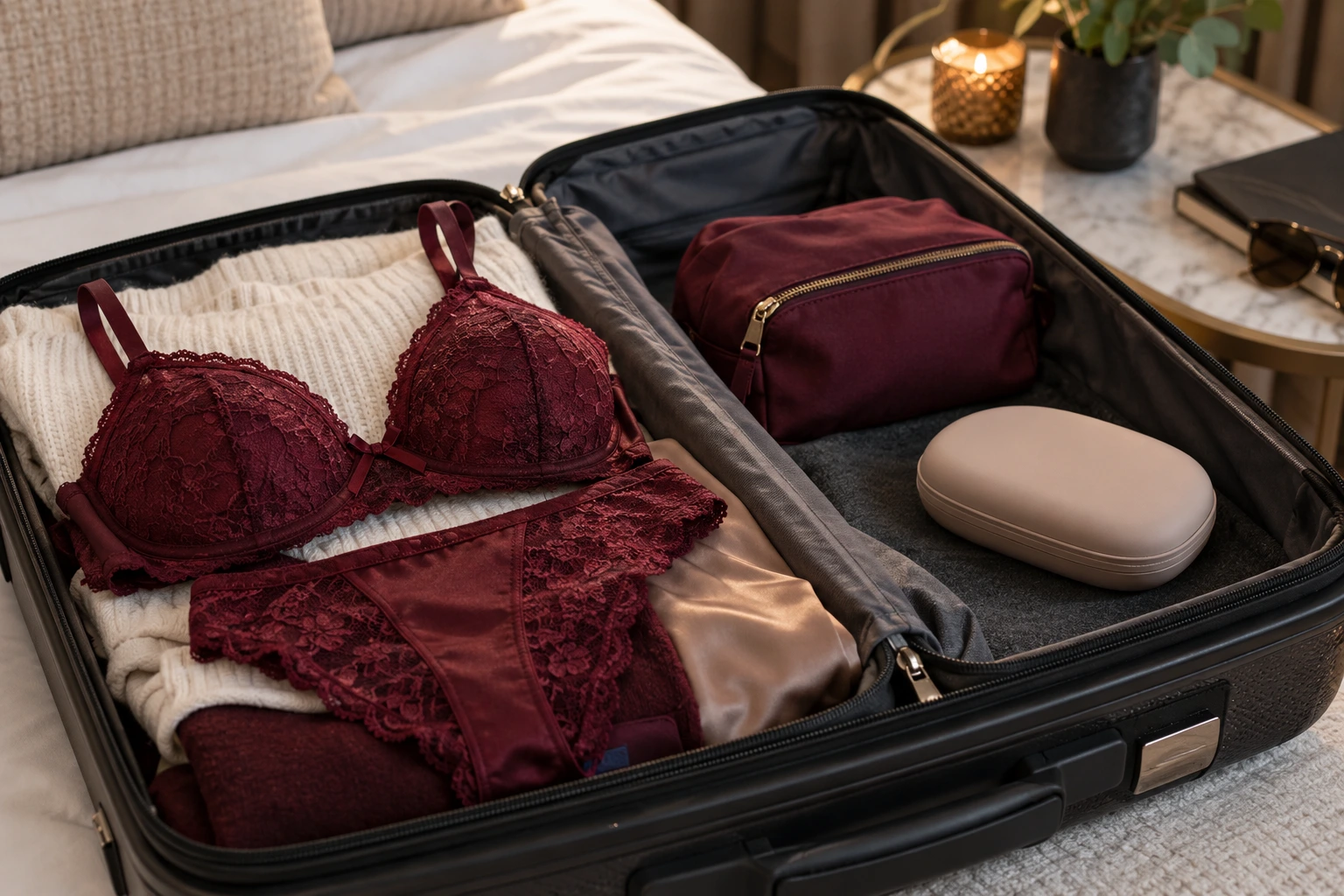
Switch the device completely off and use its travel lock if available. If an allowed device is packed in checked luggage, protect it against damage and accidental activation. A clean separate pouch keeps the accessory apart from other belongings.
Privacy does not exclude inspection
An opaque pouch offers discretion, but security staff may inspect its contents. Check liquid rules with the actual airport. If destination import restrictions are unclear, seek official guidance before departure; general blog advice cannot replace local requirements.
Check the whole route, including your return
Transport rules depend on the airline, airport and destination country. Do not check only departure from Tallinn: a transfer and return journey may have different restrictions. Find current liquid, electronic-device and battery rules for each carrier before packing. Some destinations may also restrict importing particular products. Clarify uncertainty in advance. This article is not permission to carry every accessory, and an old traveller’s review does not establish the rules that apply now.
Separate the device, power supply and liquids
Check battery type, whether it can be removed and requirements for where it travels. A spare battery and one installed in a device may be treated differently. Small size does not prove an absence of restrictions. Lubricant and cleaning products are assessed as liquids under the airport’s rules; container capacity can matter, not only the remaining amount. Keep the model description and prevent accidental activation by a permitted method. Do not travel with a damaged device or conceal battery information from inspection.
Pack for organisation, not avoiding inspection
A clean separate case protects the surface and keeps accessories apart from other items. It does not remove inspection requirements. Do not disguise an item with a false label or assume opaque packaging guarantees privacy. Answer questions calmly and truthfully. After travel, check for damage and follow permitted care before use. If route requirements are unclear or the product is unnecessary, leaving it at home may be simplest. A comfortable trip matters more than transporting the entire collection.